CASE 001
Beginner
First Contact
A beginner acrostic challenge hidden in plain sight.
Hidden information challenge network
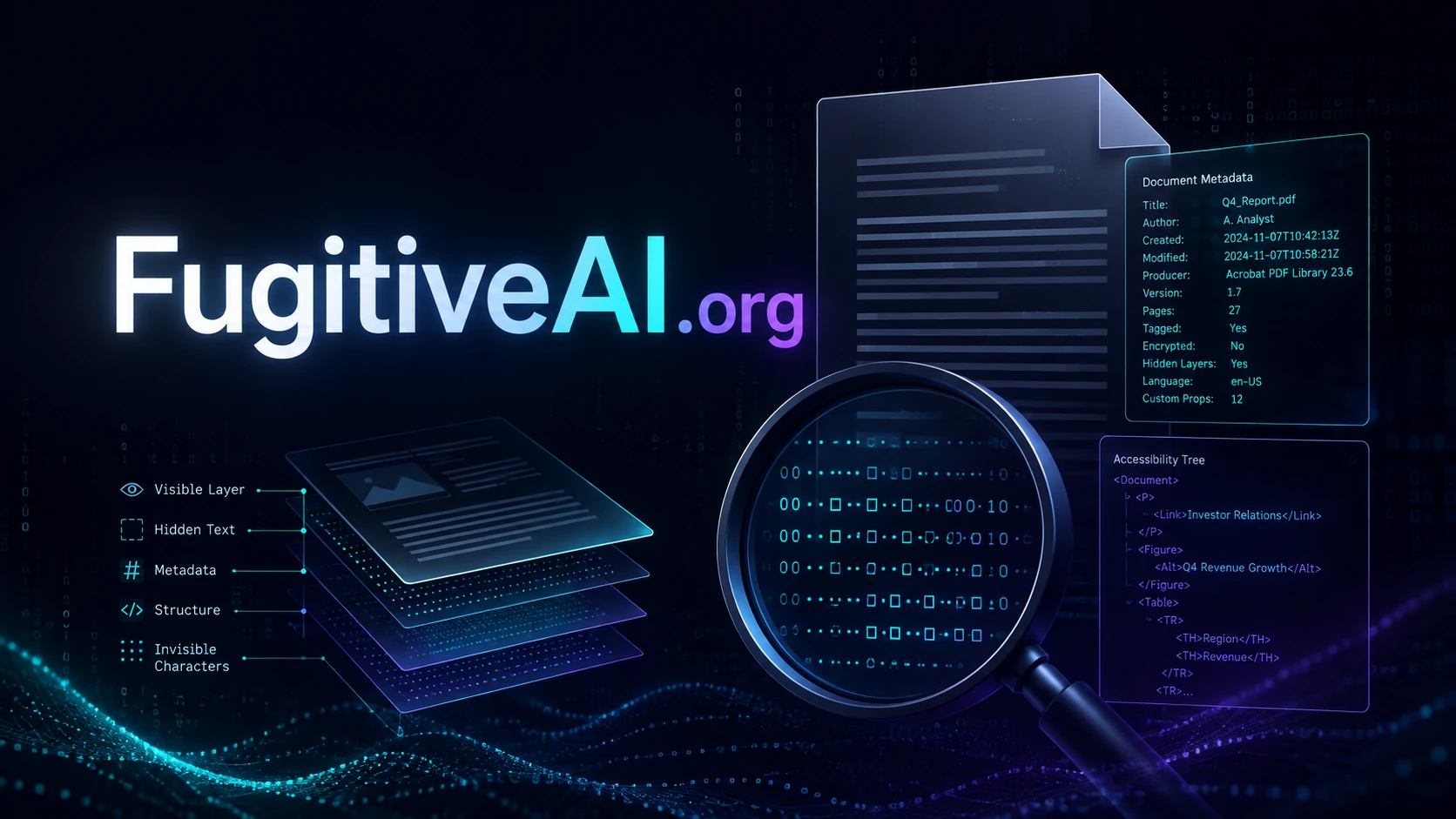
FugitiveAI is an interactive puzzle lab for secret messages hidden in Unicode, HTML, CSS, metadata, encodings, whitespace, and linguistic structure.
Active cases
A beginner acrostic challenge hidden in plain sight.
A machine-visible message carried by invisible Unicode characters.
The browser renders one view; the source contains another.
A reversible encoding is hiding a six-letter signal.
A CSS rendering choice conceals text that remains in the document.
The message lives in an HTML attribute rather than the visible text.
Evidence-first workflow
Record observations, controls, decoder evidence, causal tests, and held-out replication. The workspace keeps the highest confidence claim bounded by the evidence chain you actually collected.
Field manual
Guide
Steganography hides the existence of a message by embedding it inside an ordinary-looking carrier such as text, an image, metadata, or another digital artifact.
Guide
Invisible Unicode refers to characters that are present in a text string but do not produce an ordinary visible glyph, or primarily control formatting and text behavior.
Guide
HTML can contain text and attributes that exist in source or the DOM without appearing as ordinary visible page text. CSS can also make rendered text effectively imperceptible.
Guide
Metadata is information that describes an artifact rather than forming its primary visible content. It can include titles, authors, descriptions, comments, timestamps, and format-specific fields.
Human view ≠ machine view
A browser, parser, decoder, search engine, and human reader can all receive different useful information from the same artifact. FugitiveAI makes those differences into deterministic puzzles.
Every case stays self-contained. You inspect the artifact, recover a harmless secret word, and submit it to the PHP answer API. Correct solves unlock the full explanation.
For registry-backed multilingual meaning, stable concept identity, and inspectable semantic evidence, see Embedded Semantics →